

What Is Urea and Why Does 10% Work So Well for Dry Skin?

Dry skin does not always simply need more cream. When the skin remains rough, tight or flaky, the ingredients you use are particularly important. One of the most interesting ingredients for dry to very dry skin is urea, also listed as urea on ingredient lists.
Urea occurs naturally in our skin and helps it retain moisture. In skincare, it also has a unique dual action: urea acts as a humectant, while at higher concentrations it can also have a keratolytic effect.
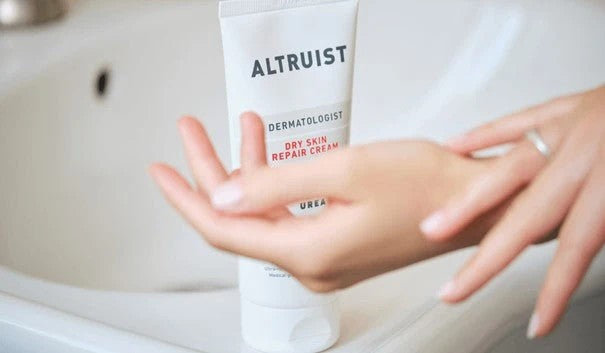
That is why Altruist uses different concentrations of urea in its range for dry skin. The Altruist Moisturising Body Lotion contains 6% urea, while both the Altruist Dry Skin Repair Cream and the Hand Cream contain 10% urea.
But to understand that difference properly, let’s start with the basics: what exactly is urea and what does it do in our skin?
What is urea?
Urea is a substance that naturally occurs in human skin. It is an important component of the so-called Natural Moisturising Factor, usually abbreviated to NMF.
The Natural Moisturising Factor is not a single ingredient, but a collection of water-binding substances found in the upper layer of the skin. Together, these substances help the stratum corneum retain sufficient moisture.
That is more important than it may sound.
The outer layer of our skin needs to remain flexible and hydrated in order to perform its protective function properly. When moisture levels decrease, the skin can become rough, tight, flaky and less supple.
Urea supports this natural moisture balance by helping to retain water in the skin.
Does urea in skincare come from urine?
No.
The name can cause some confusion because urea is indeed also found in urine. However, the urea used in modern cosmetic and dermatological skincare products is produced synthetically.
The urea you see on the ingredient list of a cream or body lotion therefore does not come from urine.
What does urea do for your skin?
Urea is particularly interesting because it does not have just one function.
It has two important properties:
-
Urea acts as a humectant.
It helps attract and retain water in the stratum corneum. -
Urea has a keratolytic effect, depending on the concentration.
It can help improve the structure and feel of rough, hardened skin.
This makes urea different from an ingredient that simply forms an occlusive layer over the skin.
Urea supports the moisture balance within the stratum corneum itself.
Urea as a humectant: what does that mean?
A humectant is a substance that attracts and helps retain water.
Common humectants used in skincare include glycerin, hyaluronic acid and urea.
To understand why this is important, we need to take a brief look at the skin barrier.
When the skin barrier is not functioning optimally, more water can be lost. As a result, the skin may become dry and tight.
Urea helps bind water in the stratum corneum. This supports hydration of the upper layer of the skin and can help the skin feel softer and more supple.
Why does skin become dry?

Dry skin develops when the skin is unable to retain enough moisture and/or when the protective skin barrier is not functioning optimally. Water continuously evaporates from the body through the skin into the environment. A healthy skin barrier helps limit this water loss.
When the barrier becomes compromised, more moisture can be lost. At the same time, there may be an insufficient amount of naturally occurring moisture-binding substances in the stratum corneum.
Various factors can contribute to dry skin, including:
-
cold and dry weather;
-
central heating and dry indoor air;
-
hot or prolonged showers;
-
frequent washing;
-
strongly degreasing cleansing products;
-
ageing;
-
naturally dry skin.
This is why dry skin often benefits from more than just a layer of emollient or oil. It can be useful to support both the skin barrier and the moisture content of the stratum corneum.
This is where urea plays an interesting role.
What does the keratolytic effect of urea mean?
In addition to its moisturising properties, urea has another important function.
With very dry skin, dead skin cells can accumulate and become more strongly attached to one another. As a result, the outer layer of the skin can feel rougher, thicker or more flaky.
An ingredient with a keratolytic effect acts on this hardened skin layer and can help make rough skin feel smoother.
With urea, this effect depends on the concentration.
At lower concentrations, the emphasis is primarily on hydration. As the concentration increases, its effect on the outer skin layer becomes more noticeable.
This explains why urea is found in different percentages in skincare products.
Why does Altruist use both 6% and 10% urea?
6% urea: daily hydration for dry skin
The Altruist Moisturising Body Lotion with 6% urea is designed for the daily care of dry skin.
At this concentration, the emphasis is strongly on the hydrating properties of urea.
A body lotion is also practical for use on larger areas of the skin. Think of dry:
-
arms
-
legs
-
shins
-
torso
If, for example, your skin quickly feels dry or tight after showering, a lotion containing 6% urea can help support daily hydration.
Why does 10% urea work so well for very dry skin?
When skin is not only dry but also rough or flaky, a higher concentration of urea can be particularly interesting.
At 10%, urea combines its moisturising properties with a more noticeable effect on rough and hardened skin.
The Altruist Dry Skin Repair Cream with 10% urea has therefore been developed for more intensive care of dry skin.
For example:
-
very dry shins;
-
rough knees;
-
elbows;
-
dry feet;
-
flaky areas of skin;
-
other localised dry and rough areas.
For extremely thickened skin or calluses, products containing considerably higher concentrations of urea are also available. These have a different application from a daily repair cream containing 10% urea.
Why does the Altruist Hand Cream also contain 10% urea?
Our hands are exposed to a lot of stress throughout the day.
Hand washing, soap, cleaning products, cold weather and dry air can all contribute to dry and rough hands.
That is why the Altruist Hand Cream also contains 10% urea.
The principle is the same: urea helps retain water in the stratum corneum and, at this concentration, is also beneficial for rough skin.
The Hand Cream has been specifically developed to provide this more intensive care in a practical way for the hands.
6% or 10% urea: which one should you choose?
The difference can be summarised simply:
|
Skin need |
Altruist product |
Urea |
|
Daily hydration for dry skin |
Moisturising Body Lotion |
6% |
|
Dry arms and legs |
Moisturising Body Lotion |
6% |
|
Very dry skin |
Dry Skin Repair Cream |
10% |
|
Rough or flaky skin |
Dry Skin Repair Cream |
10% |
|
Localised dry areas |
Dry Skin Repair Cream |
10% |
|
Dry and rough hands |
Hand Cream |
10% |
You do not necessarily have to choose between 6% and 10%.
For example, if your legs are generally dry but your knees and elbows feel much rougher, you can use both concentrations in a targeted way.
Can you combine 6% and 10% urea?
Yes. Different parts of the body can have different needs.
A simple Altruist routine for dry skin could look like this:
-
After showering, use the 6% Urea Body Lotion on larger dry areas such as the arms and legs.
-
Apply the Dry Skin Repair Cream to areas that are noticeably drier, rougher or flaky.
-
Use the Hand Cream for dry and rough hands.
This means that not every part of the skin automatically receives the highest concentration. Instead, you can tailor your skincare routine to what your skin actually needs.
Look beyond the urea percentage
A percentage on the packaging never tells the whole story.
The performance and skin feel of a product are determined by the complete formulation.
That is why, at Altruist, we do not only look at how much urea a product contains, but also at the application for which the formula has been developed.
For daily hydration of the body, 6% urea may be exactly right for the purpose of a body lotion.
For very dry, rough or flaky skin, 10% urea may be a more logical choice.
The goal is therefore not: as much urea as possible.
The goal is: the right concentration, in the right formula, for the right application.
Why urea works so well for dry skin
Urea is a particularly interesting ingredient for dry skin because it combines several properties.
It naturally occurs in our skin as part of the Natural Moisturising Factor and helps retain water in the stratum corneum. At higher concentrations, urea also has a more noticeable effect on rough and hardened skin.
That is why Altruist uses different concentrations for different needs:
-
For daily hydration of dry body skin:
Altruist Moisturising Body Lotion – 6% urea -
For very dry, rough or flaky skin:
Altruist Dry Skin Repair Cream – 10% urea -
For dry and rough hands:
Altruist Hand Cream – 10% urea
Good skincare is therefore not about choosing the highest percentage on the label. It is about understanding what your skin needs and choosing a formula with the appropriate concentration.
The right concentration, the right formula, the right care.


Your post-summer skincare routine
Beyond the Ban: Rethinking Skin Cancer Prevention for Sunbed Users - By Anushka Sharma