
Beyond the Ban: Rethinking Skin Cancer Prevention for Sunbed Users
Banning sunbeds or better education: what works best to prevent skin damage?
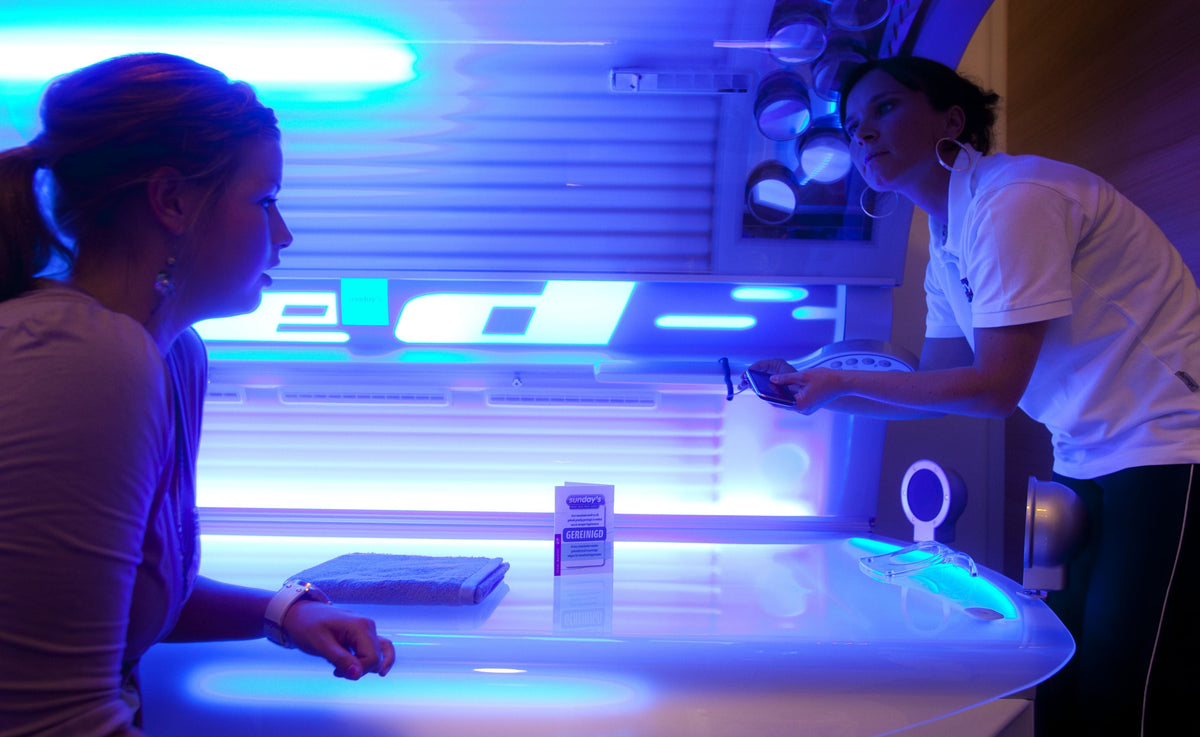
Few people walk into a tanning salon under the illusion that sunbeds are good for their skin. Most will mention wrinkles; some will mention cancer. Yet they book the appointment, lie beneath a purple wash of ultraviolet light and wait for a glow the industry still calls ‘healthy’. This is not a failure of knowledge. It is something more familiar: knowing what something may cost, and deciding the price is worth paying today. Alcohol, cigarettes and unprotected sex reveal the same inconvenient feature of human behaviour: we understand tomorrow’s risk perfectly well while remaining more interested in tonight’s reward.
There is, nevertheless, a genuine knowledge deficit: only 52% of UK 18-25-year-olds know sunbeds increase skin cancer risk (Figure 1).1 But ignorance cannot be the whole explanation; smoking’s dangers have not been secret for decades, yet cigarettes remain resistant to information alone. Some sunbed users know perfectly well, and it is this group that makes ‘just educate them’ inadequate.

1: Sunbed use and risk awareness among UK 18-25-year-olds. Department of Health and Social Care, 2026.1
The problem with ‘just educate them’
Conventional health education rests on an attractively rational model: information alters knowledge, knowledge alters behaviour. Humans have never been especially obliging. The rewards of tanning are immediate: looking better tonight, feeling confident on holiday, conforming to an aesthetic endorsed by peers and social media. Skin cancer is probabilistic, and decades away. A leaflet explaining that UV radiation damages DNA may be scientifically impeccable while remaining behaviourally optimistic. Nor is it useful to caricature sunbed users as vain or reckless. Tanning behaviour is shaped by body image, peer norms and mood, not ignorance alone.2 Appearance that motivates the behaviour is important enough to inform the intervention.
Education works better when it addresses the reason for tanning, not just its consequences. In one school-based trial, a photoaging app simulating adolescents’ own future skin increased motivation to avoid sunbeds, most strongly among fair-skinned Fitzpatrick I-II students; those at greatest melanoma risk from identical UV exposure.3,4 It worked not by adding information, but by making the risk visible now rather than abstract and later.
Risk, moreover, is not distributed uniformly (Figure 2)4. Dermatology accepts this elsewhere: for example, the SUNTRAC tool stratifies transplant recipients’ skin-cancer risk to guide screening.5 It would be strange to embrace personalised risk in clinical medicine while assuming prevention must stay one-size-fits-all. A blanket warning cannot distinguish hazard from individual risk; thoughtful education can. Even excellent education can only alter the environment of a decision, not remove the opportunity to make it.

Figure 2: Relative risk of melanoma by Fitzpatrick skin type I-IV, Type IV as baseline (RR = 1.0). Reliable relative-risk data for Types V-VI remain sparse in this literature. Gandini et al., 2005.4
A ban does something education cannot
Education changes the information surrounding a decision; regulation changes the architecture of the decision itself. UV-emitting tanning devices have been classified as carcinogenic to humans since 20096, yet an adult in England may still legally buy exposure to them. Even the under-18 prohibition is imperfect: a 2025 freedom-of-information investigation found over 200 recorded instances of under-18 sunbed use across 66 English councils since 2010, including a child aged ten, prompting the Government’s current consultation on stronger regulation.1
The conventional objection is displacement: remove legitimate salons and an illicit market, or home units, may replace them. Australia’s experience shows this is real but not dominant; search interest in indoor tanning fell to roughly a quarter of pre-ban levels, and modelling suggests a comparable UK ban could avert thousands of cancers.7,8 Circumvention argues for better enforcement, not for keeping the activity it circumvents.
Tobacco control offers a parallel: smoking declined not through more eloquent warnings, but because taxation, advertising restrictions and smoke-free environments changed what was available and socially normal. Information had allies. If forced to choose between prohibition and education alone, I would choose regulation. I would, however, resist congratulating ourselves too soon.
Ban the bed, but what about the desire?
A commercial ban removes one source of carcinogenic exposure. It does not legislate away the desire to look tanned, and that ideal now has an advertising infrastructure more pervasive than any salon window. Among young women who had recently tanned indoors, more than half reported that social media increased their desire to tan, and nearly half followed a salon’s account directly.9 Nor does eliminating indoor tanning eliminate the behaviour; even as tanning-bed use among Gen-Z declines, the desire to be tanned persists, with outdoor tanning an obvious alternative.10
We could remove every salon from the high street and leave the ideal they sell flourishing on the screen in our pockets. Education must evolve beyond the leaflet to meet a culture that is visual and algorithmic, and regulation should address misleading claims online, not just in physical premises. Public health should also offer alternatives: if what someone wants is bronzed skin rather than UV radiation itself, sunless tanning grants the outcome while removing the hazardous means.
So, ban or educate?
Perhaps the question contains a false opposition. Education can correct misinformation and, at its best, alter norms, but it asks knowledge to defeat convenience, confidence, aesthetics and immediate reward simultaneously… a formidable burden for information alone. Regulation need not persuade everyone every time; it can alter which choices are available in the first place. A commercial ban offers the stronger baseline protection, particularly for young people, and England should seriously consider one.
Yet legislation without education treats the machine while leaving untouched the reason people climb into it. ‘You should know better’ is a tempting response to apparently irrational behaviour, but rarely a useful one. Many sunbed users probably do know better. The most persuasive prevention strategy is therefore neither paternalistic prohibition nor another recital of UV radiation’s carcinogenic effects. It is regulation that removes the highest-risk option, education that speaks the language of appearance and differential risk, and messaging empathetic enough to ask why somebody wanted the tan before telling them why they shouldn’t have it.
People deserve better than being told to know better. A leaflet was never likely to outcompete an algorithm, but neither can a ban, by itself, abolish a beauty standard. The task is not merely to remove the sunbed. It is to make lying beneath one seem less desirable in the first place.
Word count: 1000
References
- Department of Health and Social Care. Strengthening the regulation of commercial sunbeds in England: consultation document. London: GOV.UK; 2026 [cited 11th September 2026]. Available from: https://www.gov.uk/government/consultations/strengthening-the-regulation-of-commercial-sunbeds-in-england/strengthening-the-regulation-of-commercial-sunbeds-in-england-consultation-document
- Holman DM, Fox KA, Glenn JD, Guy GP Jr, Watson M, Baker K, et al. Strategies to reduce indoor tanning: current research gaps and future opportunities for prevention. Am J Prev Med. 2013;44(6):672-81. doi:10.1016/j.amepre.2013.02.014
- Brinker TJ, Brieske CM, Schaefer CM, Buslaff F, Gatzka M, Petri MP, et al. Photoaging mobile apps in school-based melanoma prevention: pilot study. J Med Internet Res. 2017;19(9):e319. doi:10.2196/jmir.8661
- Gandini S, Sera F, Cattaruzza MS, Pasquini P, Picconi O, Boyle P, et al. Meta-analysis of risk factors for cutaneous melanoma: III. Family history, actinic damage and phenotypic factors. Eur J Cancer. 2005;41(14):2040-59. doi:10.1016/j.ejca.2005.03.034
- Jambusaria-Pahlajani A, Crow LD, Lowenstein S, Garrett GL, Melcher ML, Chan AW, et al. Predicting skin cancer in organ transplant recipients: development of the SUNTRAC screening tool using data from a multicenter cohort study. Transpl Int. 2019;32(12):1259-67. doi:10.1111/tri.13493
- International Agency for Research on Cancer. Sunbeds and UV radiation. Lyon: IARC; 2009 Jul 29 [cited 11th September 2026]. Available from: https://www.iarc.who.int/media-centre-iarc-news-32/
- Australian Radiation Protection and Nuclear Safety Agency. Solaria and tanning beds. Yallambie: ARPANSA; [cited 11th September 2026]. Available from: https://www.arpansa.gov.au/understanding-radiation/radiation-sources/more-radiation-sources/solaria
- Janda M. Experience from an outright ban of commercial sunbeds in the Australian context. Br J Dermatol. 2022. doi:10.1111/bjd.21582
- Moreno MA, Jenkins MC, Lazovich D. Tanning misinformation posted by businesses on social media and related perceptions of adolescent and young adult white non-Hispanic women: mixed methods study. JMIR Dermatol. 2021;4(1):e25661. doi:10.2196/25661
- University of Connecticut. Tanning bed use is down, but Gen Z still wants to be tan, so they’re going outside. UConn Today; 2026 Jul [cited 11th September 2026]. Available from: https://today.uconn.edu/2026/06/tanning-bed-use-is-down-but-gen-z-still-wants-to-be-tan-so-theyre-going-outside/


What Is Urea and Why Does 10% Work So Well for Dry Skin?