

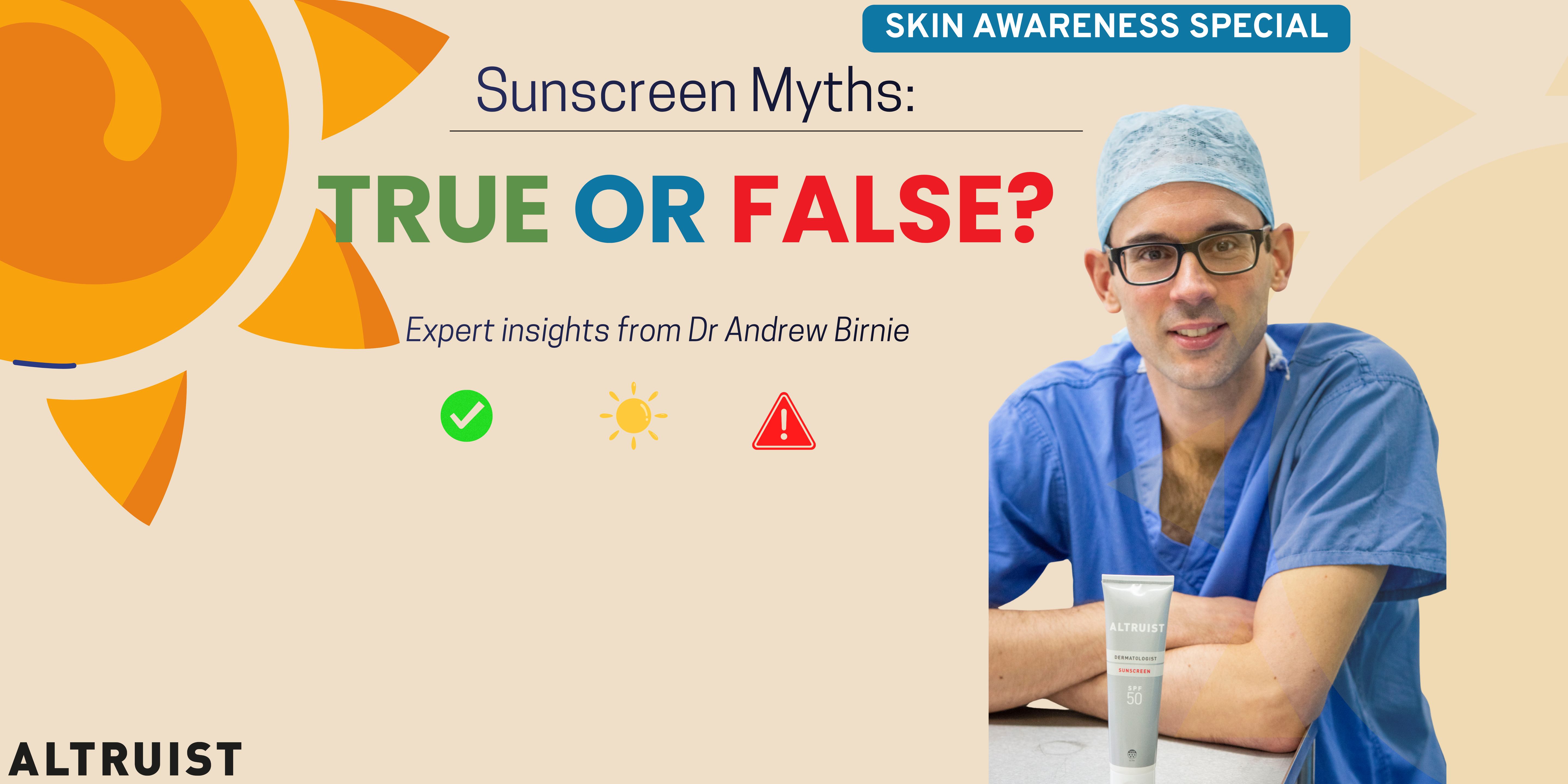
Sunscreen Myths Debunked: Insights from Dr Andrew Birnie
May is Skin Cancer Awareness Month and therefore dedicated to education, prevention and raising awareness about the importance of daily sun protection. At Altruist, our mission has always been to make high‑quality, affordable sunscreen accessible to everyone, and to help reduce the incidence of skin cancer through better awareness and habits.
Unfortunately, misinformation about sunscreen continues to spread.These myths can lead to confusion, poor protection and unnecessary risk.
In this blog, we address some of the most common sunscreen misconceptions, answered by Altruist founder, consultant dermatologist and skin cancer surgeon Dr Andrew Birnie.
Myth #1 Sunscreen causes Melanoma.
False.

This is one of the most harmful myths that exists, as sunscreen is specifically made to prevent skin damage and reduce the risk of skin cancer in general. There is no scientific evidence supporting this claim. So where does this idea come from?
A big part of the confusion comes from the population studies of earlier research and how this was interpreted: a direct correlation between the increased incidence of skin cancer and the usage of sunscreen was laid, whilst no scientific study has even proven any causation.
People who spend more time outdoors are more likely to use sunscreen, but they are also exposed to higher levels of ultraviolet radiation (UV). This UV exposure is the real driver of melanoma risk and creates a misleading association between sunscreen use and higher melanoma rates.
When we look at real population data, the bigger picture becomes clear. According to the European Cancer Information System (2022), melanoma incidence varies significantly across Europe. Some of the highest-age standardized incidence rates are found in northern European countries, including Denmark (149), Sweden (136), the Netherlands (114.5), and Ireland (72.9)
At the same time, the UK reports a much lower age-standardized rate (ASR) of 30 (Cancer Stats Data hub, n.d.). This variation shows that melanoma risk is influenced by multiple factors rather than sunscreen use alone.
To further clarify this, Dr Andrew Birnie explains: ''Some population studies have reported that people who use sunscreen appear to have a higher incidence of skin cancer. However, this is largely explained by confounding factors. These findings are often associated with the use of low SPF products (below SPF 15) and with behaviour where sunscreen is applied in order to prolong sun exposure and tanning. In other words, people using sunscreen in these cases were often deliberately spending more time in the sun, which increases their risk. So preventing skin cancer and skin aging outweighs the unproven claims that sunscreen is harmful.''
Myth #2 Chemical sunscreens are more dangerous than mineral sunscreens.

A common discussion is that chemical sunscreen filters are harmful, while mineral sunscreens are considered safer. However, this myth is based on misunderstanding rather than scientific evidence. The confusion starts with the word ‘chemical’. In reality, everything is made of chemicals, including water and minerals used in sunscreen such as zinc oxide. Chemical filters simply refer to organic UV filters that absorb UV radiation, while mineral sunscreens use physical filters that reflect UV light.
This distinction has been oversimplified in marketing and social media, which leads to perceptions that ‘chemical’ automatically means toxic.
In addition, some studies have detected sunscreen ingredients in the bloodstream under specific conditions, which has been misinterpreted as evidence or harm. However, detection of a substance does not automatically mean it's dangerous.
Dr Andrew Birnie explains: ‘‘When buying a sunscreen, you don’t have to choose between mineral and chemical UV filters, because the best approach is to combine them.
Mineral filters such as titanium dioxide provide broad-spectrum protection and have minimal systemic absorption. However, on their own, it is not possible to achieve the same elegant formulations with sufficiently high UVA protection that we can deliver in modern sunscreens. That is where organic (“chemical”) filters play an important role. They offer lighter textures, greater cosmetic comfort, and complementary coverage across the UV spectrum.
At Altruist, we therefore use hybrid combinations of mineral and chemical filters, because they provide the best of both worlds: optimal protection, good skin tolerance, and a texture that people actually want to use. Ultimately, the best sunscreen is the one you actually apply consistently. In our formulations, we use Octocrylene. It is always used at concentrations below 5%, mainly for sensory and formulation reasons. This is well below the EU-approved maximum level of 14.6%. According to the Scientific Committee on Consumer Safety (SCCS),Octocrylene is considered safe for use in cosmetic products when used within approved limits. It is also highly studied from a toxicological perspective, and there is no scientific evidence linking it to skin cancer. So, concerns about it are therefore largely based on misconception rather than regulatory or clinical evidence.''
Myth #3 Sunscreen is only necessary in the summer.
False.
For many people, sunscreen is still seen as something you only apply on hot, sunny, or beach days. Once the temperature drops or the sun feels less intense, it often disappears from daily routines.

Dr Andrew Birnie explains: ''The idea that sunscreen is only needed in summer, is a very common misconception. In reality, sunscreen should be used whenever you are outdoors in daylight for more than about 15 minutes. UV radiation is present all year around, not just on sunny days. UVA is the main driver of skin ageing and can even penetrate through clouds and glass, meaning that you are still exposed while sitting in a car or near a window. UVB, is responsible for sunburn and is stronger in summer. However, just focusing on UVB overlooks the damage caused by UVA exposure. Ideally, sunscreen should be part of your routine year-round. Personally, I apply a facial sunscreen every morning without exception from at least March to October. My own practice is to use SPF 30 as a post-shave moisturiser and then extend it to cover the face, ears and neck. If we can get people to internalise SPF in their daily routine, just like brushing your teeth we will have won the most important battles in dermatological prevention.''
Myth #4 if you apply in the morning, you’re protected the entire day.
False.

A common belief is that applying sunscreen in the morning is enough to keep you protected for the rest of the day. In reality, sunscreen does not work that way.
Dr Andrew Birnie explains: ''Sunscreen does not last all day; it should ideally be reapplied every two hours if you are outdoors to maintain adequate protection. This is especially important on hot, sunny days, when UVB levels are higher and the risk of sunburn increases.
One of the most common mistakes people make is applying too little sunscreen in the first place. The recommended amount is quite generous, around 2 mg per cm² of skin, but most people use significantly less, which reduces the level of protection. Other frequently missed areas include the ears, neck, décolleté, and the back of the hands.
Sunscreen can wear off due to sweating, swimming, or simply through daily activity, and UV filters can degrade over time when exposed to sunlight. Failing to reapply every two hours or after swimming means the level of protection drops significantly. Another common misconception is that using a high SPF removes the need to reapply. That is not the case. SPF indicates the level of protection at the time of application, not how long it lasts.’
For the face, I recommend applying sunscreen every morning as part of your daily routine, regardless of the weather. As discussed before, UVA radiation is present year-round, even on cloudy days, and can pass through window glass.''
Myth #5 Affordable sunscreen is low-quality
False.

There is a belief that cheaper sunscreens are less effective or of lower quality. For many consumers, price is often seen as a shortcut for quality; the higher the price, the better the product must be.
When it comes to sunscreen, this assumption is not necessarily true.
Dr Andrew Birnie further explains: ''I understand that perception completely. And in fact, a certain level of skepticism is healthy. But the answer is quite simple: look at the ingredients and results. At Altruist, we use the same high quality, EU-approved UV filters as many premium brands. All sunscreens sold in Europe must meet strict regulatory standards for safety and effectiveness, so a lower price does not mean lower protection. The difference lies in what we chose not to spend on. We don’t invest in multi-million-pound advertising campaigns, we don’t pay for celebrity endorsements or image royalties, and lastly we don’t focus on luxury retail environments. Those savings are passed directly on to the customer.
At the same time, my professional reputation is attached to every product. As a consultant dermatologist and skin-cancer surgeon, I cannot afford to compromise on quality. The goal is to make high-quality, effective sun protection accessible, not exclusive.''
Key takeaways
We hope this blog has helped you become more aware of common sunscreen myths and the misinformation that can circulate online. Our aim is to encourage a more critical approach to what you read and hear, and to focus on evidence rather than assumptions.
Here are some key sun safety tips to keep in mind every day:
-
Use sunscreen daily on exposed skin, especially the face, neck, and hands
-
Reapply every two hours when spending time outdoors
-
Don’t forget commonly missed areas such as ears, décolleté, and the back of the hands
-
Seek shade during the sun peak hours (12 AM and 3 PM)
Stay protected.
Team Altruist
Consulted sources:
-
ECIS - European Cancer Information System | ECIS - European Cancer Information System. (n.d.). https://ecis.jrc.ec.europa.eu/
-
Cancer Stats Data Hub. (n.d.). https://crukcancerintelligence.shinyapps.io/CancerStatsDataHub/_w_c78599a6292d40aca7588898b929c5cc/?_inputs_&nav=%22Incidence%20Breakdowns%20and%20Trends%22&app_select_CancerSite=%22Melanoma%20Skin%20Cancer%22&app_select_Country=%22United%20Kingdom%22
-
Autier, P. (2000). Do high factor Sunscreens offer protection from melanoma ? Western Journal of Medicine, 173(1), 58. https://doi.org/10.1136/ewjm.173.1.58


Octocrylen in Sonnencremes: Eine wissenschaftsbasierte Perspektive
New Product: Kids Sunscreen Roller SPF50